
Principaux enseignements :
- Visualization functions as operational infrastructure — aligning client intent, architectural design, and on-site execution in a single continuous workflow.
- Early material, lighting, and terrain refinement eliminated ambiguity — resulting in no exterior revisions and accelerated client approval.
- Responsive real-time performance enabled fluid iteration in slope-heavy, asset-dense environments — restoring design momentum without bottlenecks.
- Materials shown in render were researched, verified, and procurement-ready — reducing downstream value engineering and protecting design integrity.
Vue d'ensemble du studio
- Localisation : Philippines
- Taille de l'équipe : 20
- Type de studio : Design-Build Architecture Studio
- Types de projets : Private residential and vacation homes, resort developments, commercial buildings, and store interiors
- Outils de modélisation : ArchiCAD (technical documentation) and SketchUp (3D modeling)
Bonjour
Perched above Legazpi City with commanding views of Mayon Volcano, Solmera was conceived as a retreat from urban intensity — a private sanctuary where architecture, light, and landscape dissolve into one another.
Yet beneath its sculptural presence lies a disciplined operational framework. For Vesta Architects, a 20-person design-build studio founded in 2020, Solmera is less a residential commission than a test of alignment — between vision and execution, rendering and reality.
In a practice where the same team designs and builds, visualization cannot remain ornamental. It must function as infrastructure.

Architecture as Reveal
Solmera began with a modest request: a minimalist, homey residence. The client — a prominent Filipino celebrity — sought simplicity.
Vesta responded by amplifying identity rather than suppressing it. The resulting design embraces curvilinear forms that echo the surrounding mountains and the site’s sloping topography. The façade is restrained, almost introverted; the spatial drama unfolds only once inside through sculptural volumes, softened edges, and framed horizons.
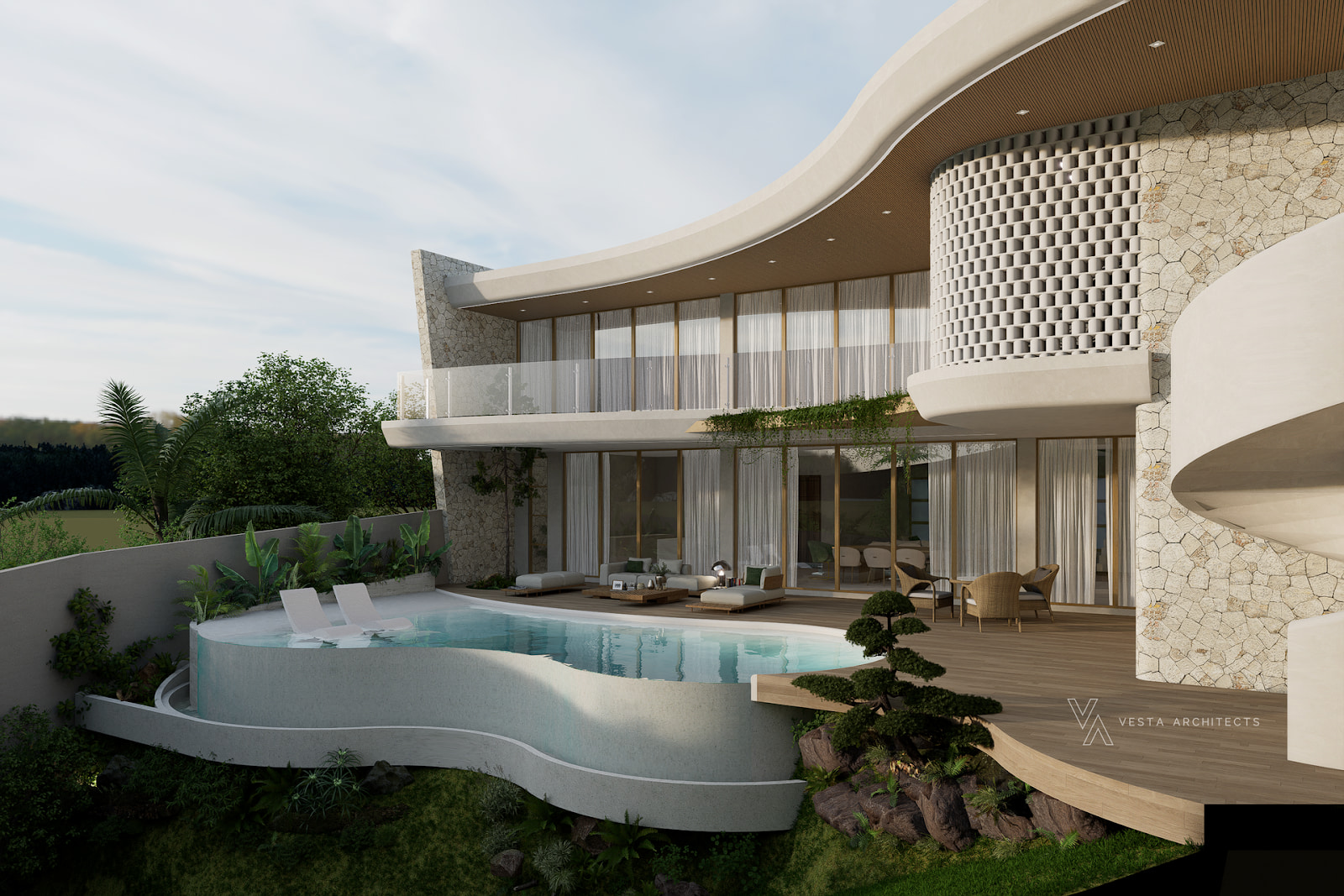
At its center, a beach-like mimic pool anchors the house, transforming it into a quiet resort suspended above the city. Private and guest zones are clearly separated, allowing solitude and hospitality to coexist without conflict.
This spatial arrangement demanded precision — particularly on a site that integrates a basement condition and complex terrain transitions.
The Role of Real-Time Tools in a Design-Build Practice
Vesta develops technical plans in ArchiCAD and volumetric studies in SketchUp before moving the model into D5 for real-time refinement. There is no dedicated 3D artist within the studio. Architects model and render their own work. This integration shortens feedback loops.
The value lies in continuity. Design adjustments, material refinements, and daylight calibration can be tested visually without restarting the process. The visual environment evolves alongside the architectural model rather than trailing behind it.
Bonjour
Within a design-build structure, this reduces friction. Renderings are not final outputs; they are coordination tools. The same perspectives shown to the client later serve as references on site.
During Solmera’s design development, the team refined material depth, daylight behavior, terrain, and landscape context directly within the real-time environment. Surface adjustments clarified how finishes would read at scale. HDRI-based daylight testing evaluated how curves and volumes performed under natural conditions. Terrain sculpting ensured the sloping site and basement relationship were spatially coherent before excavation began, while vegetation placement clarified environmental framing early.
These refinements resolved ambiguity early in the process. They clarified scale, proportion, and material presence while maintaining a direct connection to the construction intent. The exterior design required no revisions — a result that reflects both conceptual clarity and execution confidence.
Having a 3D presentation helps the client and the construction team visualize the project as a whole.
— Patricia Marbella, Senior Architect at Vesta Architects.
A lire également : D5 Bibliothèque d'actifs pour la construction de scènes rapides et de haute qualité
Terrain, Density, and Iteration
Solmera demanded careful modeling of slope, elevation, and environmental context. Exterior scenes incorporated vegetation and terrain, while interior spaces included layered finishes and detailed furnishings.
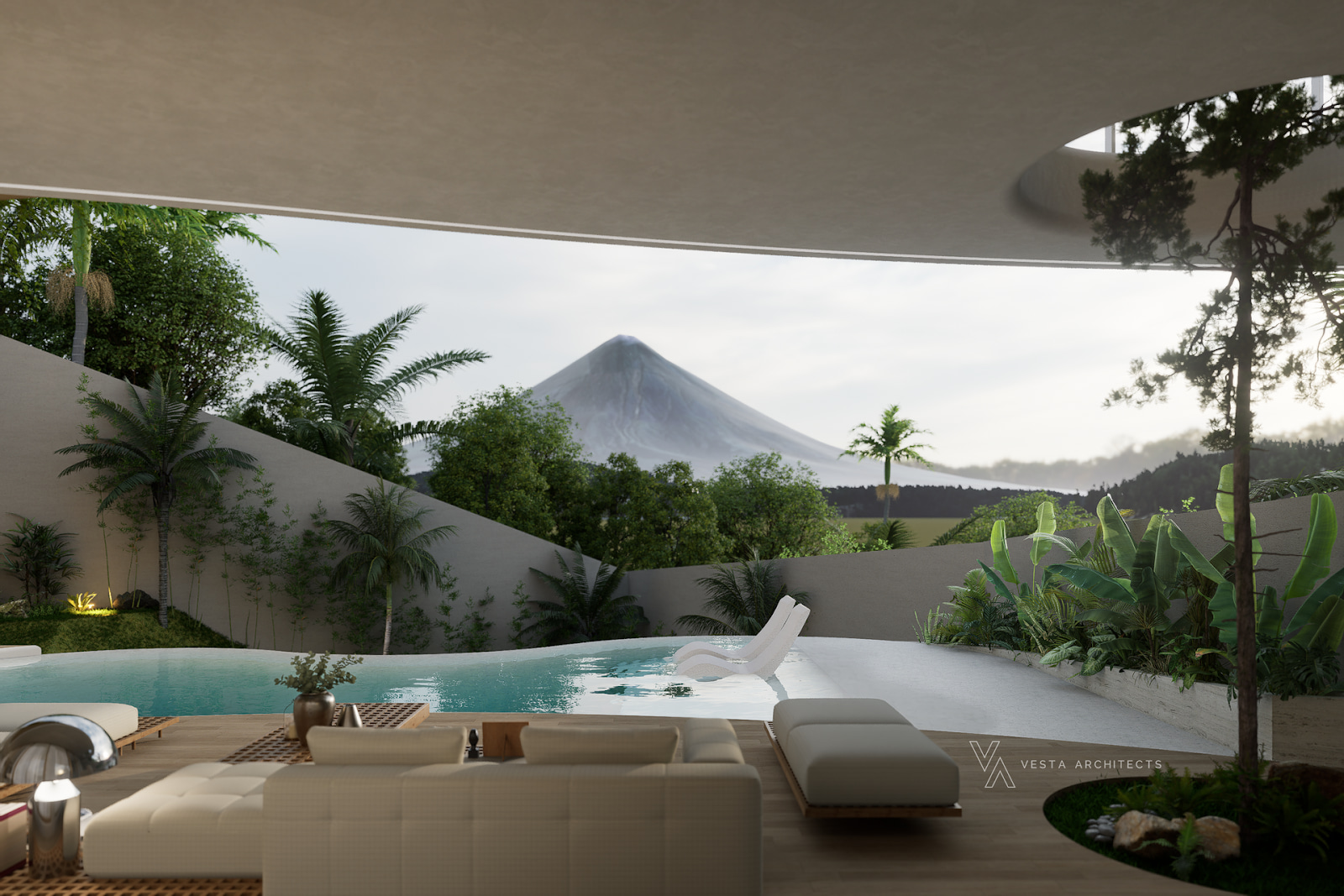
Under previous workflows with Lumion, asset-dense scenes introduced lag and slowed iteration. With a more responsive real-time environment, the same models moved fluidly. Terrain adjustments remained stable, and video outputs rendered more efficiently.
Even in studios with dedicated visualization staff, responsiveness restores momentum when architects engage directly with the rendering process. On projects like Solmera, this allows the architect to test ideas, adjust finishes, and reload updated models without dismantling the visual framework while maintaining creative control over the design exploration.
Iteration becomes continuous rather than interrupted. Real-time responsiveness restored rhythm to the workflow.
A lire également : Maîtriser l'aménagement paysager architectural avec D5 Render Terrain Tool
Rendering as Construction Instrument
Construction began in November 2025. As foundation works progressed, Solmera’s visualizations shifted from presentation tools to on-site references.
“We post those renders on site so they can visualize the actual finishes more rather than just giving them the plans and 2D graphic,” shared Patricia.
Renders are shared with contractors to communicate finish intent. Where drawings provide dimension and specification, visualization clarifies atmosphere and hierarchy — particularly in a project defined by curved envelopes, nuanced material transitions, and light-sensitive forms.
Vesta operates with a clear mandate: proposals should be virtually indistinguishable from what is built. Materials represented in the render are researched and verified before approval. Procurement considerations are addressed during design, not after.
Visualization becomes a commitment.
When rendering aligns with procurement and detailing, value engineering no longer undermines intent. Instead, execution follows the image — not the other way around.
A lire également : Rendre ce qui peut réellement être construit : Visualisation 3D pour l'architecture et la construction
Measured Alignment
Solmera is now in its third month of construction. The digitally modeled site is being shaped on the ground; sculptural volumes tested under simulated daylight are being realized in concrete.
Its significance lies not in spectacle but in measurable outcomes:
- Reduced friction between design and construction,
- Faster iteration in terrain-heavy environments,
- Minimal client revision cycles,
- Build-accurate material alignment.
Visualization does not conclude the design process, but carries it forward.
Découvrez comment le D5 s'adapte à votre processus
Vous souhaitez savoir comment ce flux de travail pourrait aider votre équipe ? Contactez-nous pour discuter des prix, planifier une démonstration ou découvrir comment D5 peut s'intégrer dans votre processus de conception.
Votre travail mérite d'être mis en lumière
Le D5 a-t-il transformé votre façon de concevoir, de présenter ou de collaborer ? Transformez votre projet D5 Render en une histoire qui inspirera les concepteurs du monde entier ! Partagez votre expérience et montrez au monde ce qui est possible.
En soumettant votre projet, vous pourriez :
✅ Faire l'objet d'une étude de cas mondiale vue par des milliers de personnes
✅ Co-animer un webinaire du D5 et présenter votre expertise
✅ Intervenez lors des événements officiels du D5 et renforcez votre présence dans l'industrie
Plus qu'un simple article, c'est l'occasion de faire entendre votre voix, de développer votre marque et d'inspirer une communauté mondiale de designers. Partagez vos histoires ici.
 English
 Español
 Français
 한국어
한국어 日本語
日本語