
Principaux enseignements :
- Chapman Taylor a repositionné la visualisation d'un résultat tardif à un outil de décision précoce, en intégrant la définition de l'ambiance assistée par l'IA et le rendu en temps réel dans le développement des concepts.
- En permettant aux architectes de produire directement des visuels prêts pour le client, le studio a réduit sa dépendance à l'égard de la CGI externalisée et a accru son contrôle sur le récit, la qualité et les cycles d'itération.
- En tirant parti des outils améliorés de D5 3.0 pour le ciel, l'océan, la végétation et l'IA, l'équipe valide les aspects climatiques, paysagers et l'intention expérientielle dès la phase de développement, ce qui améliore la clarté et réduit les frictions entre les équipes dispersées.
Vue d'ensemble du studio
- Localisation : Pratique mondiale dans 13 bureaux internationaux ; cette étude de cas se concentre sur le studio de Londres (en étroite collaboration avec le bureau de Shanghai)
- Taille de l'équipe : 73 employés dans le studio de Londres, au sein d'un cabinet mondial d'environ 380+ répartis dans 13 bureaux
- Type de studio : Cabinet international d'architecture et d'urbanisme
- Types de projets : Plans directeurs à grande échelle, hôtellerie, développements côtiers et de marinas, projets à usage mixte
- Outils de modélisation : SketchUp, Rhino, Revit
Au sein du studio londonien de Chapman Taylor, la visualisation en temps réel fait partie intégrante du processus de conception depuis plus d’une décennie. Ce que D5 a changé, ce n’est pas tant l’introduction du rendu en temps réel en soi, mais plutôt le niveau de réalisme environnemental, de contrôle de l’atmosphère et de fidélité visuelle que l’équipe a pu intégrer à ce flux de travail.
Au cours de l'année écoulée, le cabinet a intégré davantage D5 dans les premières phases de conception, s'en servant pour affiner l'évaluation de l'ambiance, des matériaux, du paysage et du climat à mesure que les projets évoluent. Initié par un directeur du bureau de Londres et progressivement adopté par la plupart des architectes de ce cabinet, ce changement visait moins à remplacer un ancien processus de travail qu'à perfectionner un processus déjà bien rodé.
Aujourd'hui, environ 80% Parmi ceux qui utilisent des outils de visualisation au bureau de Londres, certains travaillent au sein de l'équipe D5 et collaborent étroitement avec leurs collègues de Shanghai sur des projets communs. Le CGI externe n'a pas disparu, mais son rôle a évolué. Plus important encore, la visualisation intervient désormais beaucoup plus tôt dans le processus.

Du flux de travail en temps réel établi à un contrôle environnemental accru
Chapman Taylor ne partait pas de zéro. La visualisation en temps réel faisait déjà partie intégrante des processus du cabinet depuis des années, facilitant l’examen des concepts, la communication sur les projets et la prise de décision en interne. Le projet D5 a permis d’atteindre un niveau de contrôle plus avancé sur l’ambiance, le paysage et la qualité d’image au sein de ce même cadre de travail en temps réel.
Cette différence a une importance pratique. Les outils précédents permettaient de communiquer rapidement la forme et l'intention, mais l'expression environnementale était plus limitée. La direction de la lumière, la luminosité, le brouillard et une couverture nuageuse basique pouvaient être ajustés, mais la capacité à façonner des conditions climatiques nuancées, une végétation plus riche ou une narration environnementale plus immersive restait limitée.
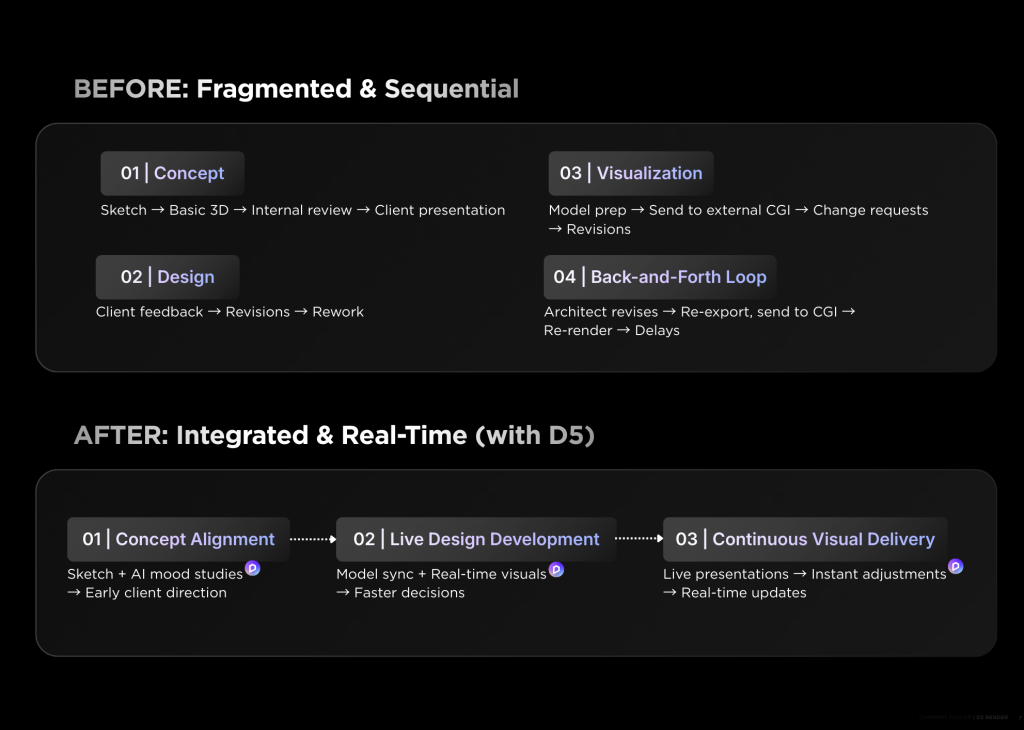
Grâce à D5 — et plus particulièrement aux fonctionnalités environnementales et d'IA introduites dans la version D5 3.0 —, l'équipe a pu intégrer un éventail plus large de conditions visuelles dans le développement de la conception en temps réel. Les modèles sont importés pendant les phases de volumétrie et de conception, tandis que les plans, les coupes et les rendus visuels continuent d'évoluer en parallèle. Les concepteurs peuvent tester les palettes de matériaux, les conditions d'éclairage, la densité de la végétation et le caractère environnemental au fur et à mesure que le projet avance, ce qui permet à l'atmosphère de jouer un rôle plus actif dans la prise de décision.
Le résultat n'est pas une réinvention totale du flux de travail du studio, mais un raffinement significatif d'un processus en temps réel déjà établi.
IA au stade de conception : clarification de l'atmosphère dès le début
Un changement clé se produit à la phase la plus précoce.
Dans le flux de travail actuel, Génération d'images par IA est utilisé parallèlement à l'esquisse pour explorer l'ambiance, l'orientation des matériaux et le ton atmosphérique. Ces études assistées par IA ne remplacent pas la modélisation ; elles servent plutôt d'outil d'alignement rapide. Elles aident à clarifier l'intention environnementale avant d'investir un effort de modélisation conséquent.
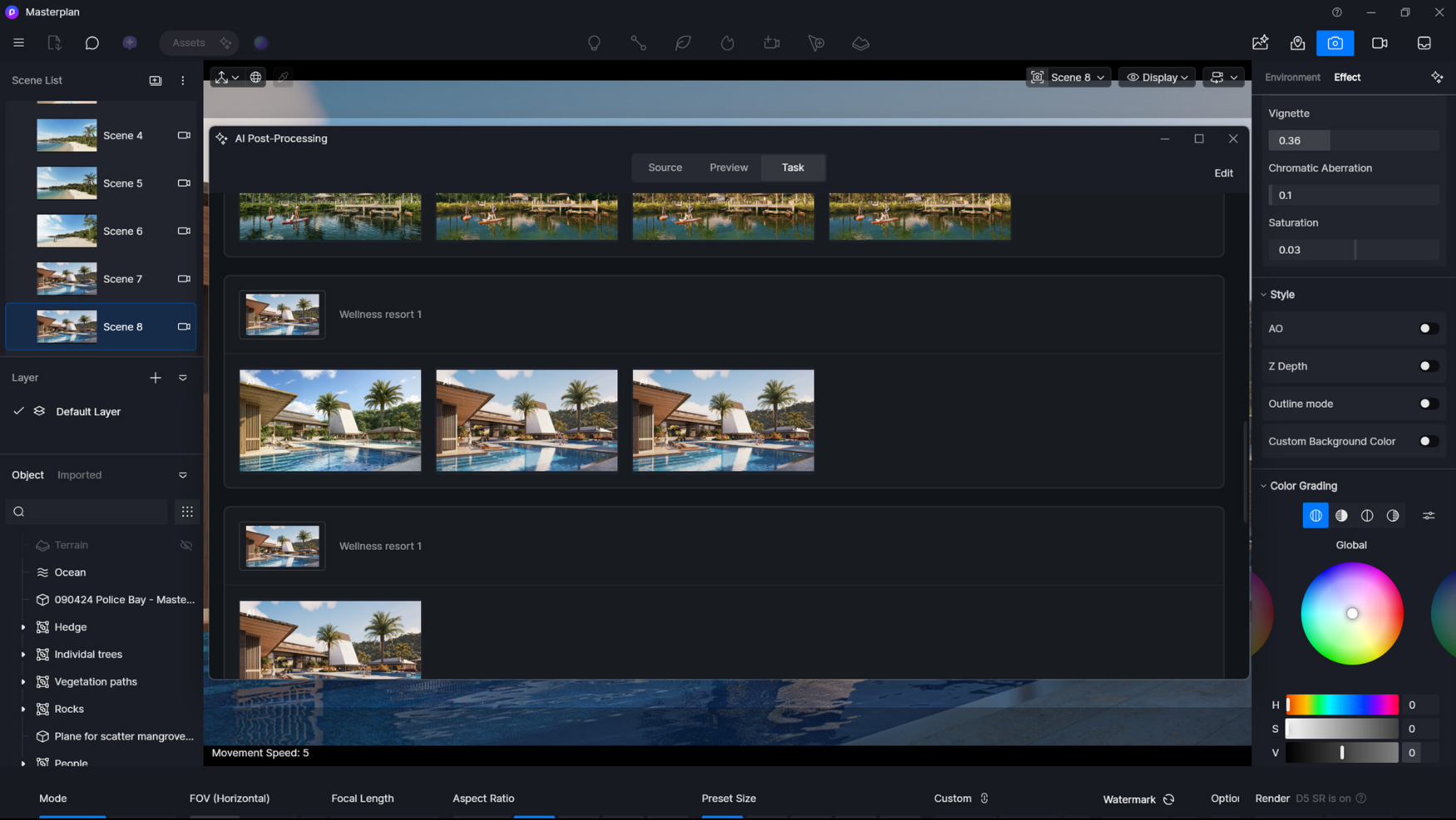
Pour les projets hôteliers et d'urbanisme, l'atmosphère est au cœur du récit. Dans les contextes côtiers ou écologiquement sensibles, la qualité du ciel, la densité de la végétation et le réalisme de l'eau influencent la perception aussi fortement que les diagrammes des volumes. En introduisant des images soutenues par l'IA dès la phase de conception, l'équipe peut confirmer la direction avec les clients plus tôt, réduisant ainsi l'ambiguïté avant que le développement du design ne s'accélère.
Les outils d'IA de D5 3.0 permettent également de rationaliser la post-production. Amélioration de l'IA affine les brouillons d'images sans les exporter vers un logiciel externe. L'inpainting est utilisé pour ajuster des éléments tels que des personnes ou le ciel. Le transfert de style est appliqué sélectivement lorsque cela est approprié, le compositing final étant géré avec soin pour maintenir le réalisme. Le résultat n'est pas une architecture automatisée, mais une réduction du travail non-conceptionnel.
A lire également : Comment rationaliser la conception des façades des bâtiments et la planification des sites dans D5 Render
Visualisation en temps réel pendant le développement
Au-delà de l’alignement des concepts, le changement plus profond réside dans l’intégration de la visualisation en temps réel au sein du développement.
Les modèles créés dans SketchUp, Rhino ou Revit sont importés rapidement dans D5. Les matériaux, les éléments de construction et les paramètres d'environnement sont configurés tandis que la géométrie reste évolutive. Les plans et les coupes évoluent en parallèle avec les visualisations en temps réel.
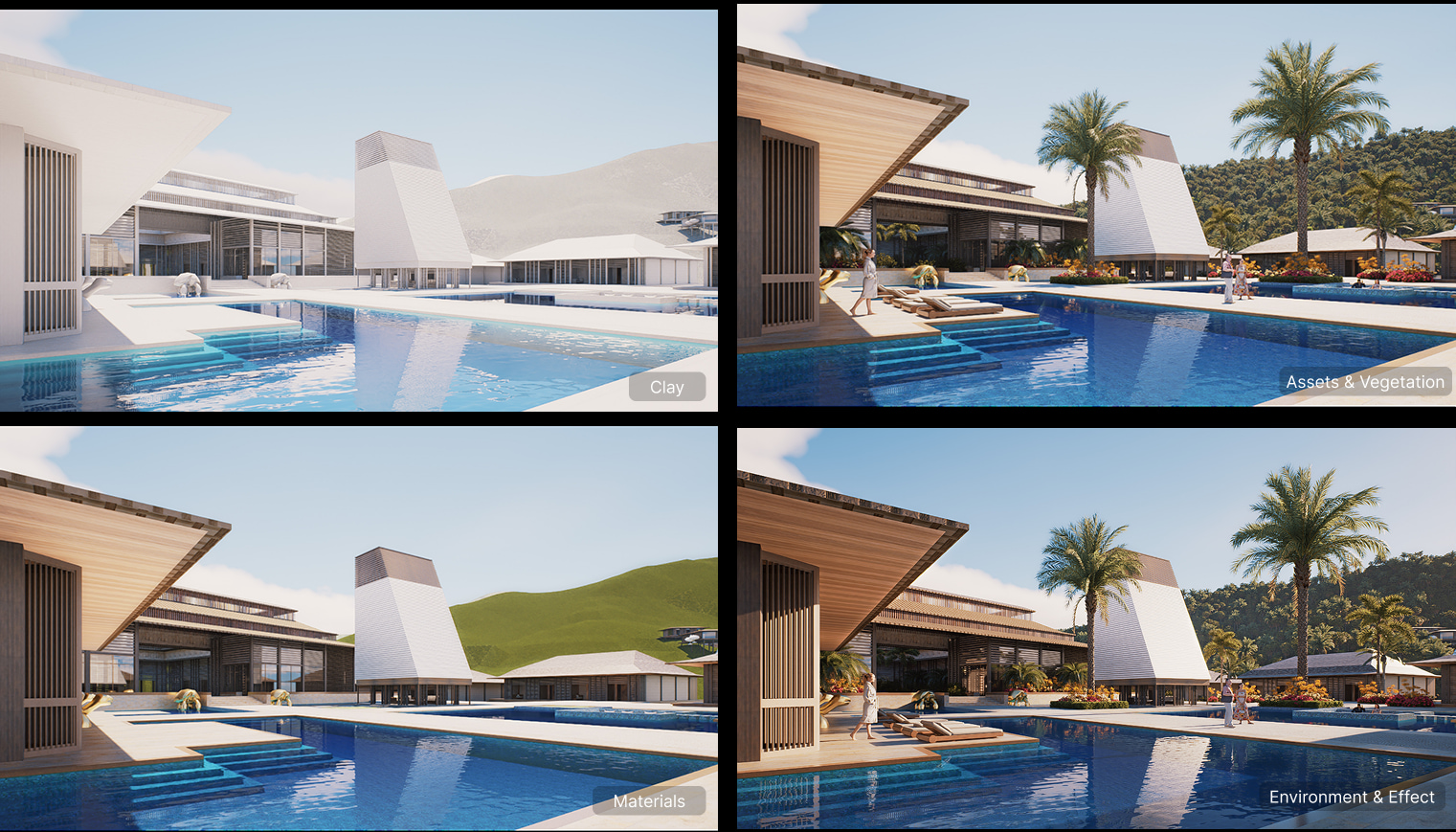
Les contrôles environnementaux de D5 3.0 sont particulièrement adaptés aux types de projets de Chapman Taylor. La fonctionnalité ’ Enhanced Geo Sky », la flexibilité HDRI, les nuages 3D volumétriques et les paramètres océaniques mis à jour permettent aux équipes de simuler les conditions climatiques avec une plus grande précision. Les ciels interagissent de manière plus réaliste avec la lumière, notamment lors des couchers de soleil ou dans les environnements côtiers où les nuances atmosphériques jouent un rôle essentiel.
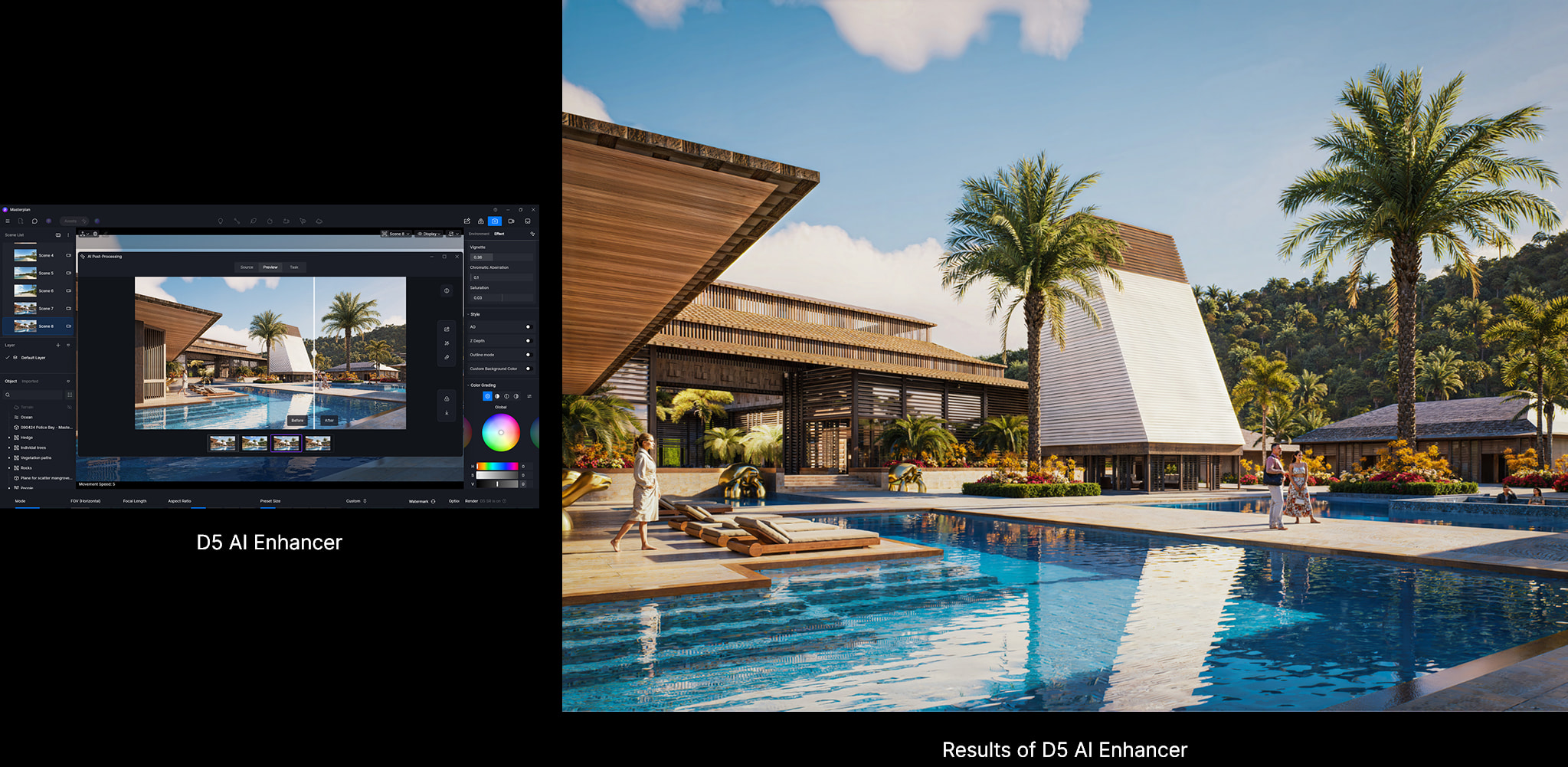
Dans le cadre de projets tels que ces grands complexes touristiques tropicaux — implantés sur des terrains escarpés et au milieu d’une végétation tropicale dense —, la crédibilité environnementale était essentielle. Grâce à la bibliothèque de végétation et aux outils de dispersion de D5, l’équipe a su peupler efficacement cette topographie complexe tout en conservant une grande variété. L’amélioration des décors marins a mis en valeur les vues sur la marina et le front de mer, donnant l’impression que l’eau s’intègre naturellement au paysage plutôt que d’apparaître comme un élément ajouté.
Pour un schéma directeur côtier, ces ajustements ne sont pas cosmétiques. L'eau, le ciel et la végétation définissent la qualité expérientielle et le positionnement concurrentiel.

A lire également : Nuages volumétriques : Remplacement du ciel sans effort pour les architectes
Designers en tant que producteurs visuels
D'un point de vue organisationnel, le changement est tout aussi important.
Au sein du studio londonien, il n'existe pas de service dédié à la visualisation chargé de la production D5. Les architectes et les assistants architectes travaillant sur un projet réalisent eux-mêmes les visuels correspondants. Cela permet de réduire le recours à des spécialistes de la visualisation pour la plupart des images à hauteur des yeux. On fait toujours appel à des images de synthèse externes, notamment pour les vues aériennes ou les rendus marketing haut de gamme, mais celles-ci ne constituent plus le pilier de chaque présentation.
Les projets menés à Londres et à Shanghai, qui mobilisent souvent une dizaine de collaborateurs, se caractérisent par un travail collaboratif dès la phase de conception : différents contributeurs développent des zones ou des éléments distincts avant que l'ensemble ne soit intégré dans un modèle global. Cependant, lorsque la visualisation est développée dans D5, la coordination devient généralement plus centralisée. Un utilisateur principal se charge généralement d'organiser la scène, de définir le langage environnemental et de préparer le modèle pour la production d'images, afin que l'atmosphère, l'ambiance et la direction artistique restent cohérentes dans tous les résultats finaux.
Le rôle de l'artiste CGI s'est donc orienté vers le peaufinage plutôt que vers la construction de base. Les rendus D5 servent souvent d'images de base solides, les partenaires externes se chargeant d'améliorer certaines vues phares plutôt que de reconstruire des scènes entières.
Impact mesuré
Bien que les gains initiaux de calendrier aient été notables, l'impact plus large a été structurel. Une phase de plan directeur conceptuel qui aurait pu auparavant prendre un mois peut maintenant être réalisée en 3 semaines, même si le studio produit davantage de visuels en interne qu'auparavant.
En interne, l'équipe rapporte des améliorations mesurables des performances du flux de travail.
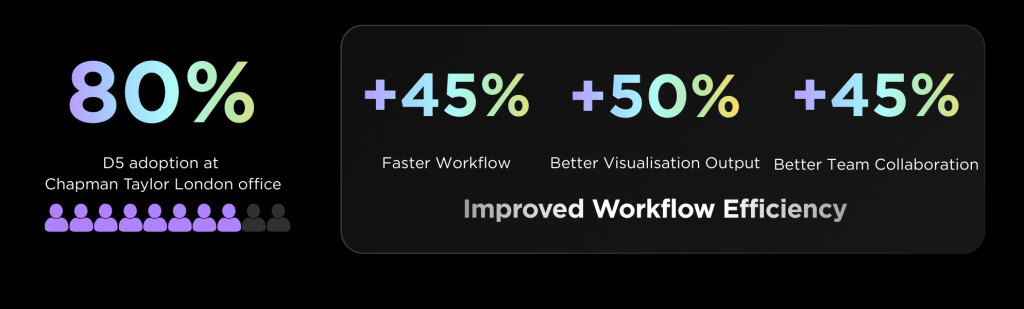
Ces gains reflètent une coordination plus fluide entre les designers, moins de cycles de refonte et un alignement visuel plus clair entre les bureaux.
Ces améliorations opérationnelles se reflètent également dans la communication avec les clients. Les vues du travail en cours sont partagées plus tôt et plus fréquemment, permettant aux parties prenantes de mieux appréhender l'intention spatiale et atmosphérique avec une plus grande clarté.
“La communication avec le client est plus claire qu'auparavant, car si nous montrons une vue de l'avancement des travaux, il comprend immédiatement ce qu'il va obtenir.”
— Amalia Radasanu, assistante en architecture Part I, Chapman Taylor (Londres)
Les concepteurs peuvent tester des options en direct — ajustant la volumétrie, la densité de la végétation ou l'éclairage et évaluant immédiatement le résultat.
Le résultat n'est pas juste une accélération progressive, mais un flux de travail de visualisation plus intégré et collaboratif.
Évolution continue
Des défis subsistent. Les grands ensembles de plans directeurs fusionnés peuvent solliciter le matériel et nécessitent une gestion attentive de la scène. La collaboration entre Londres et Shanghai, qui couvrent des fuseaux horaires différents, ajoute de la complexité en matière de coordination, en particulier lorsque les modèles doivent être convertis, fusionnés et ajustés entre différents fuseaux horaires et styles de travail. Pour gérer cela, les équipes s'appuient sur des flux de travail de fusion structurés, des sélections d'actifs clairement définies dès le début d'un projet et des préréglages environnementaux partagés pour maintenir la cohérence visuelle. Établir des limites sur les types de végétation, les bibliothèques de matériaux et les réglages atmosphériques avant l'assemblage de la scène réduit les désalignements et minimise les reprises dans les différents bureaux.
Pourtant, la trajectoire est claire.
En intégrant plus profondément les capacités en temps réel et d’intelligence artificielle de D5 3.0 dans son processus de conception, le studio londonien de Chapman Taylor a perfectionné la visualisation pour en faire un outil de conception véritablement intégré. L’atmosphère est définie avec davantage de nuances. La crédibilité environnementale est testée de manière plus convaincante au cours du développement. L’imagerie de synthèse externe devient un outil de perfectionnement stratégique plutôt qu’une production par défaut.
La transformation ne consiste pas simplement à produire de meilleures images. Il s'agit de redéfinir l'importance des images – et d'intégrer l'atmosphère dans la conversation architecturale dès le départ.
Découvrez comment le D5 s'adapte à votre processus
Vous souhaitez savoir comment ce flux de travail pourrait aider votre équipe ? Contactez-nous pour discuter des prix, planifier une démonstration ou découvrir comment D5 peut s'intégrer dans votre processus de conception.
Votre travail mérite d'être mis en lumière
Le D5 a-t-il transformé votre façon de concevoir, de présenter ou de collaborer ? Transformez votre projet D5 Render en une histoire qui inspirera les concepteurs du monde entier ! Partagez votre expérience et montrez au monde ce qui est possible.
En soumettant votre projet, vous pourriez :
✅ Faire l'objet d'une étude de cas mondiale vue par des milliers de personnes
✅ Co-animer un webinaire du D5 et présenter votre expertise
✅ Intervenez lors des événements officiels du D5 et renforcez votre présence dans l'industrie
Plus qu'un simple article, c'est l'occasion de faire entendre votre voix, de développer votre marque et d'inspirer une communauté mondiale de designers. Partagez vos histoires ici.
 English
 Español
 Français
 한국어
한국어 日本語
日本語